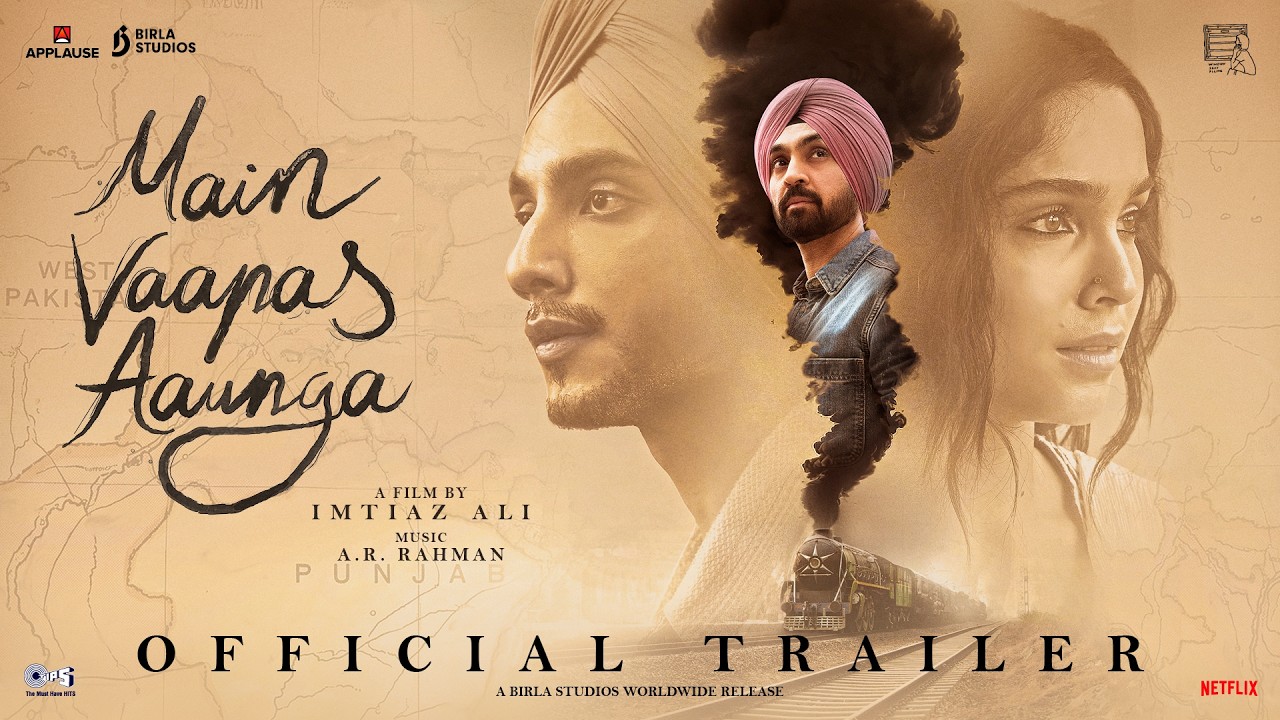
Main Vaapas Aaunga Imtiaz Ali Movie 2026 Bapamtv Review Details
Main Vaapas Aaunga (2026) Review – Imtiaz Ali’s Poetic Masterpiece That Will Leave You With A Lingering Ache!
Yaar, when I first heard that Imtiaz Ali was making a Partition love story with Diljit Dosanjh and Naseeruddin Shah, I thought, “Bas kar bhai, itna emotion ek saath kaise handle karega?” But then I watched Main Vaapas Aaunga in a packed hall in Mumbai, and honestly, I was not prepared for the tears that followed. This is not just a film; it is a feeling that stays with you long after you leave the theatre.
Quick Summary: Main Vaapas Aaunga is a Hindi romantic drama (not Punjabi, as some might assume) that weaves two timelines together. In the present, Nirvair (Diljit Dosanjh) returns from London to reconnect with his dying grandfather Ishar Grewal (Naseeruddin Shah), who is haunted by the 1947 Partition. The film then takes us back to pre-Partition Sargodha, where young Ishar (Vedang Raina) falls deeply in love with Afsana (Sharvari), a Muslim girl. Their love story unfolds against the backdrop of a nation tearing itself apart, and the question remains: will love survive the Radcliffe Line?
Main Cast & Crew
| Role | Name | Character Description |
|---|---|---|
| Nirvair | Diljit Dosanjh | London-based youth reconnecting with his grandfather’s past |
| Ishar Grewal (Old) | Naseeruddin Shah | Dying man haunted by Partition memories |
| Keenu (Young Ishar) | Vedang Raina | Carefree young Ishar in pre-Partition Sargodha |
| Afsana Shaikh (Jiya) | Sharvari | Coy and resolute young woman who falls for Ishar |
| Director | Imtiaz Ali | Signature poetic romantic storytelling |
| Music Composer | A.R. Rahman | Soulful album enhancing emotional depth |
| Lyrics | Irshad Kamil | Poetic verses capturing longing |
| Cinematography | Sylvester Fonseca, ISC | Bridging two eras with visual coherence |
| Editor | Aarti Bajaj | Seamless interweaving of timelines |
| Production Designer | Suman Roy Mahapatra | Period-accurate Sargodha and Delhi settings |
| Sound Designer | Dhiman Karmakar | Dual role ensuring consistent audio quality |
| VFX Studio | Phantom FX | Seamless timeline transitions |
| Color Studio | Redchillies.color | Warm nostalgic tones for Partition era |
| Producers | Sameer Nair, Deepak Segal | Birla Studios & Applause Entertainment |
| Music Label | Tips Music Limited | Complete album distribution |
1. The Entertainment Factor – A Rollercoaster of Emotions
Bhai, Imtiaz Ali knows one thing very well: how to make you feel. Main Vaapas Aaunga is not a typical mass entertainer with item numbers and punch dialogues. It is a slow-burn emotional ride that grips you from the first frame. The first half is filled with the innocence of young love – the chhup-chhupake meetings in the garden, the stolen glances, the fear of being caught. But then the second half hits you like a truck. The Partition scenes are raw, painful, and beautifully shot. There were moments in the theatre where the entire hall was silent, just absorbing the pain on screen. This is not a film you watch for mindless entertainment; this is a film you experience.
Insight: Imtiaz Ali’s genius lies in making the personal political. The love story here is not just about two individuals; it is about the millions of families torn apart by the Partition.
2. Star Performance – Diljit and Naseeruddin Shah Own the Screen
Let me start with Naseeruddin Shah. Yaar, what can I say that hasn’t been said? The man delivers a masterclass in acting. His portrayal of Ishar Grewal – a man broken by memories, carrying the weight of a love he could never complete – is haunting. Every wrinkle on his face tells a story. Every pause in his dialogue delivery speaks volumes. When he says “Main vaapas aaunga,” you feel the pain of a promise that could never be fulfilled.
Diljit Dosanjh as Nirvair brings his natural charm and swagger, but he also shows surprising depth. His scenes with Naseeruddin Shah are the emotional backbone of the film. You can see the respect and love in his eyes for the veteran actor. Diljit proves once again that he is not just a Punjabi star; he is a national treasure when it comes to emotional roles.

But the surprise package for me was Sharvari. As Afsana, she is coy, resolute, and heartbreakingly real. Her vulnerability in the scenes where she realizes the love of her life might be lost forever will stay with you. And Vedang Raina as young Ishar brings the perfect carefree energy that contrasts beautifully with his older self.
3. Direction & Vision – Imtiaz Ali’s Return to Form
After the mixed reactions to Love Aaj Kal 2, many wondered if Imtiaz Ali had lost his touch. Main Vaapas Aaunga answers that question with a resounding NO. This is Imtiaz at his poetic best. The way he transitions between the two timelines is seamless, almost like memories flowing naturally. The Radcliffe Line becomes a character in itself – a dividing line not just between countries, but between two lovers.
His signature style of long, lingering shots of characters thinking, the sound of silence speaking louder than dialogues, and the use of natural landscapes to mirror emotional states – all of it is present here. The Sargodha of 1947 is captured with such authenticity that you can almost smell the citrus orchards. And present-day Delhi is shown as a city that has forgotten its history, much like Nirvair initially does.
Insight: Imtiaz Ali uses the Partition not just as a backdrop but as a metaphor for the partitions we all experience in relationships – the distance that grows between two people even when they are in the same room.
4. Dialogues & Action Blocks – Clap-Worthy Moments
Since this is not an action film, the “action blocks” here are the emotional confrontations. The dialogues, penned by Imtiaz Ali and Nayanika Mahtani, are poetry in motion. Some lines that will stay with you:
- “Pyaar mein koi Hindu nahi hota, koi Muslim nahi hota. Sirf do dil hote hain jo ek saath dhadakte hain.” (In love, there is no Hindu, no Muslim. Only two hearts that beat together.)
- “Main vaapas aaunga, lekin kaun jaanta hai ki woh din aayega bhi ya nahi?” (I will return, but who knows if that day will ever come?)
- Naseeruddin Shah’s monologue about crossing the border with nothing but memories is one of the most powerful scenes in recent Hindi cinema. The entire theatre was in tears.
Mass Elements Checklist
| Element | Rating (Out of 5) | Comments |
|---|---|---|
| Romance | ⭐⭐⭐⭐⭐ | The core strength of the film. Pure, heartbreaking, and real. |
| Emotional Impact | ⭐⭐⭐⭐⭐ | Naseeruddin Shah’s performance alone is worth the ticket. |
| Music / BGM | ⭐⭐⭐⭐½ | A.R. Rahman elevates every scene. |
| Dialogues | ⭐⭐⭐⭐½ | Poetic and quotable. Imtiaz at his best. |
| Performances | ⭐⭐⭐⭐⭐ | Every single actor delivers. Sharvari is a revelation. |
| Action / Thrills | ⭐⭐ | Not the focus. Emotional intensity substitutes for action. |
| Comedy | ⭐⭐⭐ | Limited, but genuine moments of warmth. |
| Visual Appeal | ⭐⭐⭐⭐⭐ | Sylvester Fonseca’s cinematography is stunning. |
5. Music & BGM – A.R. Rahman’s Soulful Touch
Yaar, A.R. Rahman and Imtiaz Ali – name a better duo. The music of Main Vaapas Aaunga is not just background; it is a character in itself. The album, with lyrics by Irshad Kamil, includes tracks like “Kya Kamaal Hai,” “Maskara,” “Vo Nahin,” “Ishq Mastana,” “Dheere Dheere,” and the haunting “Tere Paas Main” in both male and female versions. Rahman’s BGM during the Partition sequences is particularly powerful – the dissonant notes and traditional instruments create a sense of impending doom that perfectly complements the visuals.

Insight: The track “Vo Nahin” plays during the climax, and I guarantee you will not be able to hold back tears. Rahman has composed it in such a way that the absence of the lover becomes the central note of the song.
6. Cinematography & Technical Craft – Visual Poetry
Sylvester Fonseca, the director of photography, deserves a special mention. The way he captures Sargodha in 1947 – the golden hues of the citrus orchards, the narrow lanes, the warmth of community living – is breathtaking. In contrast, present-day Delhi is shot in cooler tones, showing a city that has moved on from its past. The color grading by Redchillies.color is superb, making the Partition era feel like a fading photograph that is slowly losing its colors.
The sound design by Dhiman Karmakar is equally impressive. The sounds of the train whistles, the chaos of the riots, and the silence of separation – all are layered beautifully. The technical team has created a world that feels both historically accurate and emotionally resonant.
7. Emotional High Points – The Heart Connection
There are three moments in this film that will break you completely:
- The Train Scene: When young Ishar and Afsana are separated at the railway station, and she runs alongside the moving train. The helplessness in their eyes will haunt you for days.
- The Old Age Revelation: When Naseeruddin Shah’s character finally reveals what happened to Afsana, the entire theatre was in pin-drop silence. I heard people sobbing around me.
- The Climax: Diljit’s character makes a decision that honors his grandfather’s love. It is not a typical Bollywood ending, but it is the most honest ending Imtiaz could have given this story.
Who Will Enjoy This?
| Audience Segment | Enjoyment Level | Reason |
|---|---|---|
| Imtiaz Ali Fans | ⭐⭐⭐⭐⭐ | Classic Imtiaz – poetic, emotional, and beautifully told. |
| Romantic Drama Lovers | ⭐⭐⭐⭐⭐ | One of the best love stories of the decade. |
| History Buffs | ⭐⭐⭐⭐⭐ | Authentic portrayal of Partition era. |
| Family Audience | ⭐⭐⭐⭐ | Some intense scenes, but overall a family-friendly emotional journey. |
| Youth (18–25) | ⭐⭐⭐⭐ | Might find the pace slow, but the emotional payoff is worth it. |
| Mass / Commercial Audience | ⭐⭐⭐ | Lacks massy elements like action and comedy. Purely emotional. |
| Fans of Diljit Dosanjh | ⭐⭐⭐⭐⭐ | His best performance in a Hindi film yet. |
8. Box Office Prediction – Verdict
Bhai, Main Vaapas Aaunga opened with Rs 1.38 crore on Day 1, which is modest for a film of this stature. It is trailing behind Love Aaj Kal 2 in terms of initial numbers. But here is the thing – this is not a commercial masala film. This is a film that will find its audience through word of mouth. Critics have already given it 3.5 stars, praising it as “a poetic and deeply emotional tale of unfinished love.”
My prediction: The film will have a slow but steady run at the box office. It might not break records, but it will be remembered as one of the finest romantic dramas of 2026. For Imtiaz Ali fans, this is a return to his roots. For everyone else, this is a film that will stay with you.

Star Rating Breakdown
| Parameter | Rating (Out of 5) |
|---|---|
| Story & Screenplay | ⭐⭐⭐⭐½ |
| Acting Performances | ⭐⭐⭐⭐⭐ |
| Direction | ⭐⭐⭐⭐½ |
| Music & BGM | ⭐⭐⭐⭐½ |
| Cinematography & Visuals | ⭐⭐⭐⭐⭐ |
| Emotional Impact | ⭐⭐⭐⭐⭐ |
| Overall Entertainment | ⭐⭐⭐⭐ |
Frequently Asked Questions
1. Is Main Vaapas Aaunga a Punjabi movie or Hindi?
Despite some confusion online, Main Vaapas Aaunga is a Hindi-language romantic drama directed by Imtiaz Ali. While Diljit Dosanjh is a Punjabi star, the film’s dialogues, songs, and screenplay are primarily in Hindi, with some Punjabi and Urdu phrases woven in for authenticity.
2. Is this film based on a true story?
While the film is not a direct biopic, it is inspired by real stories of people during the Partition of India in 1947. Imtiaz Ali and his team researched personal accounts of separation, loss, and impossible love. The emotional core of the film is rooted in the real experiences of millions who were divided by the Radcliffe Line.
3. Should I watch Main Vaapas Aaunga in theatres or wait for OTT?
Yaar, I will be honest – this film demands a theatre experience. The cinematography by Sylvester Fonseca, the sound design by Dhiman Karmakar, and the music by A.R. Rahman are all designed for the big screen. The emotional impact of the Partition scenes, the silence of the theatre when Naseeruddin Shah delivers his monologue – these moments will not translate the same way on a mobile screen. Go watch it in a theatre near you.
Ratings are purely my take after multiple watches — your experience might differ!