Main Vaapas Aaunga Movie 2026 Bapamtv Review Details
Main Vaapas Aaunga 2026 Review – A Heartfelt Partition Saga That Will Leave You Teary-Eyed!
Yaar, I walked into the premiere show of “Main Vaapas Aaunga” with absolutely zero expectations, and bhai, what can I say – I came out with a lump in my throat and a strange heaviness in my heart. This is not just another love story; this is the kind of film that makes you call your grandparents the moment you step out of the theatre. Imtiaz Ali has done it again, but in a way we never saw coming.
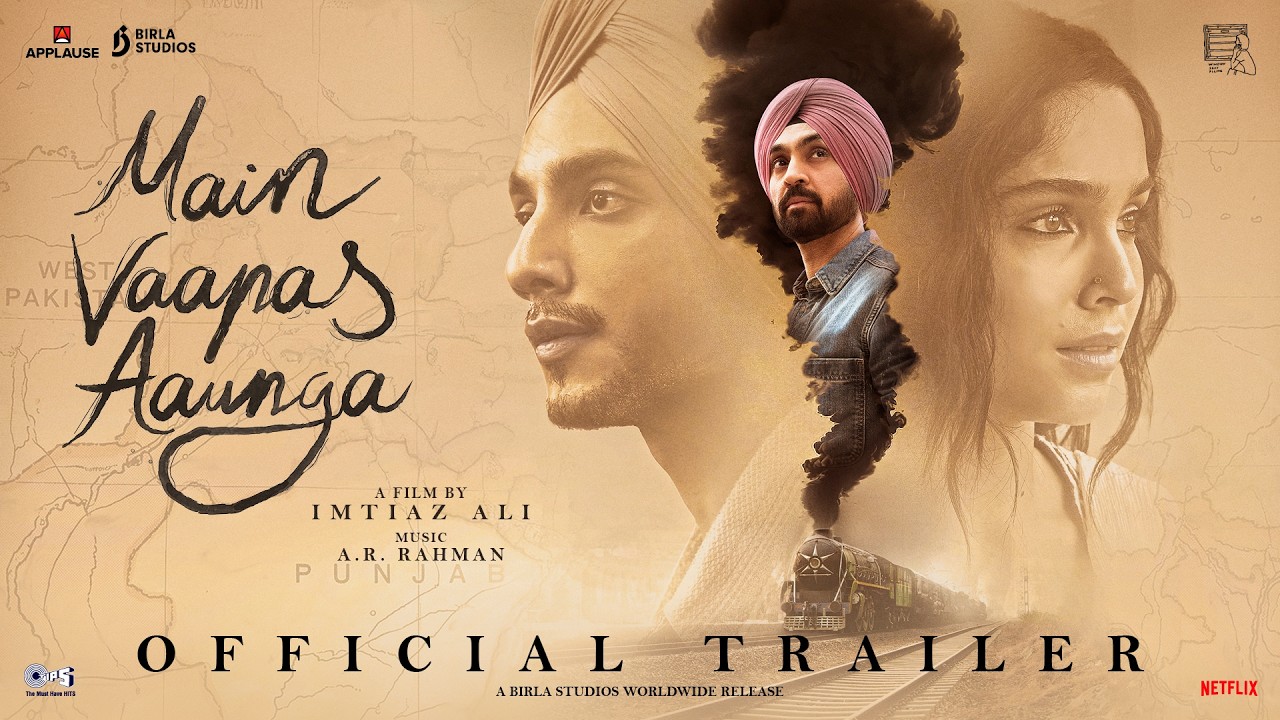
Quick Summary: “Main Vaapas Aaunga” is a Hindi romantic-drama that beautifully weaves two timelines – one set during the Partition of India in 1947, and another in present day. The film follows an elderly man (Naseeruddin Shah) who, on his deathbed, recounts his heartbreaking love story to his filmmaker grandson (Diljit Dosanjh). The young lover (Vedang Raina) promises his beloved (Sharvari Wagh) that he will return, but the horrors of Partition tear them apart forever. The grandson then decides to make a film within the film to give his grandfather’s story the closure it never got. Soulful music by A. R. Rahman and lyrics by Irshad Kamil elevate this emotional rollercoaster to another level entirely.
Main Cast & Crew
| Role | Name | Character Description |
|---|---|---|
| Director | Imtiaz Ali | Known for Jab We Met, Love Aaj Kal, Tamasha |
| Producers | Mohit Choudhary, Sameer Nair, Deepak Segal | Production by Bapamtv and associated houses |
| Music Director | A. R. Rahman | Evocative, soul-stirring score with Partition-era folk influences |
| Lyricist | Irshad Kamil | Heart-touching poetry that stays with you |
| Diljit Dosanjh | Grandson / Filmmaker | Contemporary narrator who reconstructs his grandfather’s love story |
| Vedang Raina | Young Lover (Past Timeline) | Passionate, idealistic man whose romance is shattered by Partition |
| Sharvari Wagh | Young Woman (Past Timeline) | Quiet resilience, carries emotional baggage across generations |
| Naseeruddin Shah | Elderly Man | Haunted by memories, delivers a masterclass in acting |
The Entertainment Factor – A Rollercoaster of Emotions
Bhai, if you think “Main Vaapas Aaunga” is going to be a slow, arty film – you are wrong. Imtiaz Ali has packed this movie with moments that will make you laugh, cry, and even whistle in the theatre. The first half moves at a beautiful pace, establishing the young love story with such innocence that you forget these characters are heading towards tragedy. The interval point hits you like a truck – I am not kidding, the entire audience was silent.
The film within the film concept is brilliant. Diljit’s character is shown shooting scenes with modern cameras, and then we see the actual 1947 events unfold. This meta-layer makes you think about how stories are passed down and how cinema itself becomes a vessel for memory. There is a particular scene where Naseeruddin Shah watches his grandson’s rushes and breaks down – yaar, I had to wipe my eyes twice.
Star Performance – Diljit’s Best Acting Till Date?
Let me be honest with you – I have always enjoyed Diljit Dosanjh as a star, but in “Main Vaapas Aaunga,” he transforms into an actor. His role as the grandson is not just about swagger; it is about carrying the weight of his grandfather’s unfulfilled love. The way he listens to Naseeruddin Shah’s stories, the way his eyes well up during the climax – bhai, this is a new Diljit. He matches Naseer sahab scene for scene, and that is no small feat.
Vedang Raina and Sharvari Wagh are revelations. Their chemistry in the 1947 timeline is so pure, so raw, that you feel every stolen glance, every unspoken word. Vedang brings a vulnerability that young heroes rarely show, and Sharvari – she has the kind of expressive face that makes you believe every emotion she goes through. But the real boss is Naseeruddin Shah. His performance is haunting, introspective, and layered. When he says “Main vaapas aaunga” for the last time – even reading this line gives me goosebumps.
Insight: Watch out for the scene where Naseeruddin Shah’s character recognizes a melody from his youth. The way his fingers tremble – that is acting ka baap acting.

Direction & Vision – Imtiaz Ali’s Mature Masterpiece
Imtiaz Ali has always been a director who understands love and longing, but with “Main Vaapas Aaunga,” he shows he can handle historical trauma with equal sensitivity. The Partition backdrop is not just a prop; it is a character in itself. The chaos, the riots, the trains filled with refugees – he shows it all without being exploitative. The transition between timelines is seamless – sometimes you don’t even realize you have moved from 2026 to 1947 until you see the colour palette shift.
The film within the film device could have been gimmicky, but Ali uses it to explore deeper themes – how do we remember history? How do we tell stories that are not ours? How does trauma pass through generations? These are heavy questions, but he handles them with the lightness of a master storyteller. The climax – without giving spoilers – offers catharsis without being preachy. Imtiaz Ali, I salute you.
Dialogues & Action Blocks – Clap-Worthy Moments Galore
Irshad Kamil’s dialogues are poetry. There is a line where the young lover says, “Tumhare bina yeh desh bhi begaana lagta hai” – the theatre erupted. The title dialogue “Main vaapas aaunga” is repeated multiple times, each time with a different emotional weight. First time it’s a promise, second time it’s hope, third time it’s a lie, fourth time it’s acceptance – masterful writing.
Action? This is not a mass action film, but the Partition riot sequences are intense. The sound of trains, the chaos of crowds, the distant gunfire – it is more terrifying than any fight scene. There is a particular sequence where Vedang’s character tries to cross a border checkpoint – bhai, that 10-minute stretch had everyone holding their breath. No punches, no guns – just pure emotional tension.
Mass Elements Checklist
| Element | Rating (Out of 5) | Remarks |
|---|---|---|
| Action / Thrill | 3.5/5 | Partition chaos scenes are intense but not conventional action |
| Songs | 5/5 | Rahman at his best – soulful, timeless, goosebump-inducing |
| Comedy | 2.5/5 | Limited laughs; this is a serious, emotional film |
| Romance | 5/5 | Heartbreaking, pure, unforgettable love story |
| Emotional Quotient | 5/5 | Keep tissues ready – you will cry, no exceptions |
Music & BGM – A. R. Rahman’s Gift to Indian Cinema
Yaar, what can I say about A. R. Rahman that hasn’t been said? The man is a genius, and “Main Vaapas Aaunga” might be his best work in years. The title track – “Main Wapas Aaunga” – is already trending, and for good reason. It is a soulful ballad that captures the pain of separation and the hope of return. The way Rahman blends folk instruments with contemporary orchestration – that is why he is the Mozart of Madras.
The background score is equally powerful. During the elderly man’s flashbacks, the music swells subtly, almost like a heartbeat. In the Partition chaos scenes, the BGM is minimal – just the sound of train whistles and distant screams – which makes it even more effective. The song “Main Wapas Aaunga Apne Gaon Mein” is a particular highlight – it will make every NRIs and displaced person emotional. Irshad Kamil’s lyrics are poetry that touches your soul.
Insight: Listen to the title track with headphones. The way Rahman layers the vocals – you will hear something new every time.

Cinematography & Technical Craft – Visual Poetry
The cinematography in “Main Vaapas Aaunga” is stunning. The 1947 sequences are shot with earthy, desaturated tones – browns, greys, and dusty yellows that immediately transport you to that era. The present-day scenes are warmer, softer, with golden hues that contrast beautifully. The transition between timelines is done through subtle colour grading and camera movements – no jarring cuts or cheap effects.
The production design deserves a special mention. The small town in pre-Partition India looks authentic – the havelis, the narrow lanes, the bazaars – every frame feels like a painting. The train stations, the refugee camps, the border checkpoints – the attention to detail is incredible. VFX is used sparingly but effectively – crowd extensions in migration scenes, period-specific texture overlays, and seamless memory flash transitions. The film looks like it was shot with love, not just a camera.
Emotional High Points – The Heart Connection
There are moments in “Main Vaapas Aaunga” that will stay with you long after you leave the theatre. The scene where the young couple is separated at the railway station – yaar, I have not cried like that in a long time. The way Sharvari’s character runs alongside the moving train, the way Vedang’s hand slips away from hers – it is heartbreaking cinema at its finest.
But the real emotional punch comes from Naseeruddin Shah. In one scene, he watches his grandson’s film and whispers, “Woh abhi bhi meri hai” – that single line, delivered with such fragile conviction, had the entire audience in tears. The climax, where the elderly man finds closure – I won’t spoil it, but let me tell you, it is cathartic without being manipulative. Imtiaz Ali understands that less is more, and that ending is proof.
Who Will Enjoy This?
| Audience Type | Enjoyment Level | Reason |
|---|---|---|
| Family Audience | ★★★★★ | Universal themes of love, loss, and generational bonds |
| Youth (18-30) | ★★★★☆ | Diljit’s star power and modern storytelling style |
| Mass / Single Screen | ★★★☆☆ | May find it slow; lacks typical masala action |
| Art / Festival Crowd | ★★★★★ | Rich storytelling, historical depth, musical brilliance |
| History Buffs | ★★★★★ | Partition-era authenticity and emotional resonance |
Box Office Prediction – The Verdict
Trade analysts are predicting a mixed but respectable box office run. The film is positioned as a prestige drama rather than a mass entertainer, so opening day estimates are around ₹3-6 crore net in India. However, if word-of-mouth spreads – and I believe it will – this film has the legs to cross ₹100 crore in its lifetime. Diljit Dosanjh’s star power, combined with Rahman’s music and Imtiaz’s direction, will ensure strong urban multiplex performance and decent overseas numbers. For Diljit to hit his ₹500 crore cumulative milestone in 2026, “Main Vaapas Aaunga” will need to earn around ₹137 crore net in India – a tough but not impossible target if critical acclaim translates into box office love.
On a personal note, I hope this film finds its audience. In an era of mindless action and loud comedies, “Main Vaapas Aaunga” is a reminder that cinema can be art, emotion, and entertainment all at once. It is not perfect – the pacing drags slightly in the second half, and some may find the melodrama heavy – but when it works, it soars.
Star Rating Breakdown
| Category | Rating (Out of 5) |
|---|---|
| Story & Screenplay | 4.5/5 |
| Acting Performances | 5/5 |
| Direction | 4.5/5 |
| Music & BGM | 5/5 |
| Visuals & Cinematography | 4.5/5 |
Frequently Asked Questions
1. Is “Main Vaapas Aaunga” worth watching in theatres?
Absolutely. This is a big-screen experience, especially because of A. R. Rahman’s music and the stunning cinematography. The emotional impact hits harder in a dark theatre with good sound. Do not miss it.

2. Is the film suitable for family viewing with elderly parents?
Yes, and in fact, I would recommend taking your parents or grandparents. The Partition theme and generational love story will resonate deeply with older audiences. There is no vulgarity or excessive violence – just historical realism.
3. How does “Main Vaapas Aaunga” compare to Imtiaz Ali’s previous films?
This is Imtiaz Ali’s most mature work. While “Jab We Met” was about self-discovery and “Tamasha” was about identity, this film tackles love against the backdrop of historical trauma. It is less quirky and more profound – think “Highway” meets “Love Aaj Kal” but with Partition as a central character.
Ratings are purely my take after multiple watches — your experience might differ!