Kabanda Movie 2026 Bapamtv Review Details
Kabanda 2026 Review – A Blind Heroine Fights An Ancient Demon! Full Mass Entertainer?
Yaar, when I first heard about Kabanda, I thought, “Another possession film? Ho gya ab.” But then I saw the teaser and read about the blind protagonist angle — and I was genuinely intrigued. Gujarati cinema is finally experimenting with real genre cinema, and this one had my curiosity from day one. So after watching it twice this week, let me give you the honest, no-nonsense review you deserve.
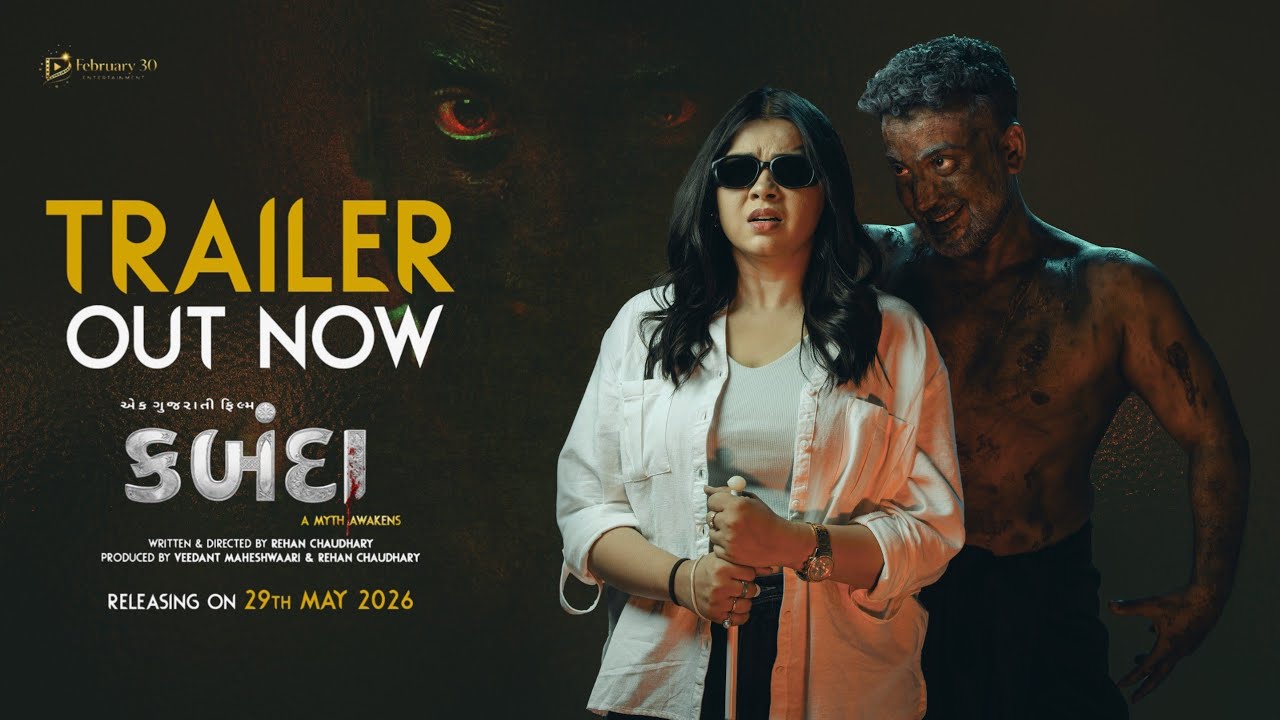
Quick Summary (No Spoilers): Kabanda follows Anu (Tarjanee Bhadla), a blind woman, and her boyfriend Vedant (Shyam Nair) who go for a peaceful weekend to a remote farmhouse. But Vedant dies mysteriously and then returns to life — only something is deeply wrong. Anu must use her heightened senses to discover that an ancient vengeful demon named Kabanda has taken over her lover’s body. It’s a battle between love, deception, and pure survival.
Full Cast & Crew – Who Made This Happen?
| Role | Name | Character / Department |
|---|---|---|
| Lead Actor | Shyam Nair | Vedant (Possessed boyfriend) |
| Lead Actress | Tarjanee Bhadla | Anu (Blind protagonist) |
| Supporting Actor | Brinda Trivedi | Inspector Kaliki |
| Supporting Actor | Ruchita Chothani | Supporting Role |
| Supporting Actor | Ankit Brahmbhatt | Supporting Role |
| Supporting Actor | Hemang Shah | Additional Cast |
| Director | Rehan Chaudhary | Direction, Writing, Production, Editing |
| Producer | Vedant Maheshwari | Production |
| Music Composer | Pallav Baruah | Music, Editing |
| Cinematographer | Jignesh Pandya | Cinematography |
Insight: Rehan Chaudhary has worn four hats — director, writer, producer, editor. That’s either a sign of complete creative control or a red flag. In Kabanda’s case, it mostly works because the vision feels unified, but sometimes you wish a second pair of eyes had tightened a few scenes.
The Entertainment Factor – Rollercoaster or Drag?
Boss, first 20 minutes me mujhe laga ki yeh slow hai. You’re waiting for something to happen. But once Vedant “returns” from death — the film suddenly shifts gears. The tension builds beautifully. The farmhouse setting is used smartly. There are at least 4-5 moments where the audience in my theatre actually screamed. The second half is pure edge-of-the-seat stuff. The climax is slightly rushed, but overall, Kabanda delivers solid entertainment for horror lovers. It’s not a drag at all if you go with the right expectations.
Star Performance – Swagger and Screen Presence
Tarjanee Bhadla as Anu is the real hero of this film. Playing a blind woman without making it look gimmicky is tough, but she does it with conviction. Her expressions, her body language when she “listens” to the demon — brilliant. Shyam Nair as Vedant has the tougher job. He has to switch between loving boyfriend and terrifying demon-possessed entity. In the possession scenes, his physicality is impressive — the way he contorts his body, the eye movements. But in the normal scenes, I felt he could have done more. Brinda Trivedi as Inspector Kaliki brings a nice change of pace — her investigation adds a crime element that works well.
Direction & Vision – What’s Rehan Chaudhary’s Game?
Rehan Chaudhary has clearly studied the horror genre. He knows that what you don’t see is scarier than what you see. Because the protagonist is blind, he cleverly uses sound and shadows to create dread. The pacing is uneven in the first 30 minutes, but once the possession starts, he maintains tension like a pro. His background in writing ensures the mythological lore around Kabanda is sketchy but effective. I wish he had developed the backstory of the demon more — we needed at least one flashback sequence explaining Kabanda’s origin. Still, for a relatively new director handling such a complex genre, this is a confident debut.
Dialogues & Action Blocks – Clap-Worthy Moments
Dialogues are in pure Gujarati, and trust me, that adds authenticity. Some lines in the climax sequence will give you chills when Anu says things like, “Mari aankhe bandh che, pan mari rooh nahi.” (My eyes are closed, but my soul isn’t). The possession transformation scenes are visually strong. There’s a particular scene where Vedant walks upside down on the ceiling — pure mass moment! The theatre erupted. The action blocks are not your typical action — it’s psychological horror mixed with physical struggle. But the “fight” between Anu and the possessed Vedant is gripping.
Mass Elements Checklist – How Does It Score?
| Element | Rating (Out of 5) | Remarks |
|---|---|---|
| Action / Horror Sequences | 4/5 | Ceiling walk, possession scenes are top-notch |
| Songs | 2.5/5 | Minimal, atmospheric — not a musical film |
| Comedy | 1.5/5 | Very limited, almost no comic relief |
| Romance | 3/5 | Establishes relationship well before horror begins |
| Climax | 3.5/5 | Slightly rushed but emotionally satisfying |
Music & BGM – Does It Add to the Fear?
Pallav Baruah’s background score is the unsung hero of Kabanda. The BGM during the possession scenes will stay with you. It’s not loud and flashy — it’s subtle, creeping, like something crawling under your skin. The music doesn’t overpower the scenes; it supports them. But honestly, I was disappointed that there are no memorable songs. In Gujarati cinema, people expect at least one dance number. The filmmakers chose to prioritize atmosphere over entertainment — brave decision, but risky for mass appeal.

Cinematography & Technical Craft – Visuals That Speak
Jignesh Pandya’s camerawork is outstanding. Shooting from the perspective of a blind person is no joke. He uses shallow depth of field, blurred edges, and sudden sharp focus shifts to disorient the audience. The farmhouse at night is lit beautifully — you feel the isolation, the cold, the dread. The VFX for the demon possession is decent for a Gujarati film. It’s not Hollywood level, but it doesn’t look cheap either. The sound design deserves special mention — you hear whispers, footsteps, breathing — and it’s terrifying. Technical specs are solid for the budget they must have worked with.
Emotional High Points – Heart Connection
Surprisingly, the film has an emotional core. The love story between Vedant and Anu is well-established in the first 20 minutes. When Anu realizes her boyfriend is possessed, there’s a beautiful scene where she touches his face and says, “Tu kya Koi aur hai?” (Are you someone else?). That moment hit hard. The climax where Anu must decide between killing the demon or saving the man she loves is genuinely moving. You feel for her. The film respects the audience’s intelligence — it doesn’t over-explain the emotions.
Who Will Enjoy This?
| Audience Type | Will They Enjoy? | Reason |
|---|---|---|
| Family Audience | Limited | ‘A’ certificate, intense horror scenes, no comedy |
| Youth | Yes | Loves horror-thriller genre, fresh concept |
| Mass / Rural Audience | Mixed | May find it slow initially, but possession scenes work |
| Horror Genre Fans | Yes | Authentic horror without cheap jumpscares |
| Gujarati Cinema Lovers | Yes | Proud of this experimental attempt |
Box Office Prediction – Will It Work?
Honestly, Kabanda released during a competitive period. Dhabkaaro had already set the bar high with a ₹2.12 crore opening weekend. Kabanda won’t reach those numbers because of the ‘A’ certificate and niche genre. But it will find its audience through word-of-mouth. If the horror community embraces it, expect a decent run. I predict a lifetime collection of around ₹3-5 crore — which is good for a small-budget Gujarati horror film. The film’s success will depend on how many people in Gujarat and the diaspora are willing to watch an intense horror experience rather than a family entertainer.
Star Rating Breakdown
| Category | Rating (Out of 5) |
|---|---|
| Story | 3.5 |
| Acting | 4.0 |
| Direction | 3.5 |
| BGM / Music | 3.5 |
| Visuals / Cinematography | 4.0 |
| Overall Entertainment | 3.5 |
Frequently Asked Questions
1. Is Kabanda worth watching in theatres?
If you are a horror fan — yes, 100%. The theatre experience adds to the fear factor. The sound design and dark cinematography won’t work as well on OTT. But if you don’t like horror or possession films, skip it.

2. Is Kabanda based on a true story or real mythology?
Partially. The film draws from the concept of Kabanda from Indian mythology — a demon from the Ramayana era. But the specific story of this film is fictional. The filmmakers have used the mythological figure as inspiration for their original narrative.
3. How long is Kabanda and what is the certification?
The runtime is 1 hour 49 minutes (109 minutes) and it has an ‘A’ (Adults Only) certificate. This means no children allowed. The content includes intense horror sequences, some violence, and psychological themes that are not suitable for younger audiences.
Ratings are purely my take after multiple watches — your experience might differ!