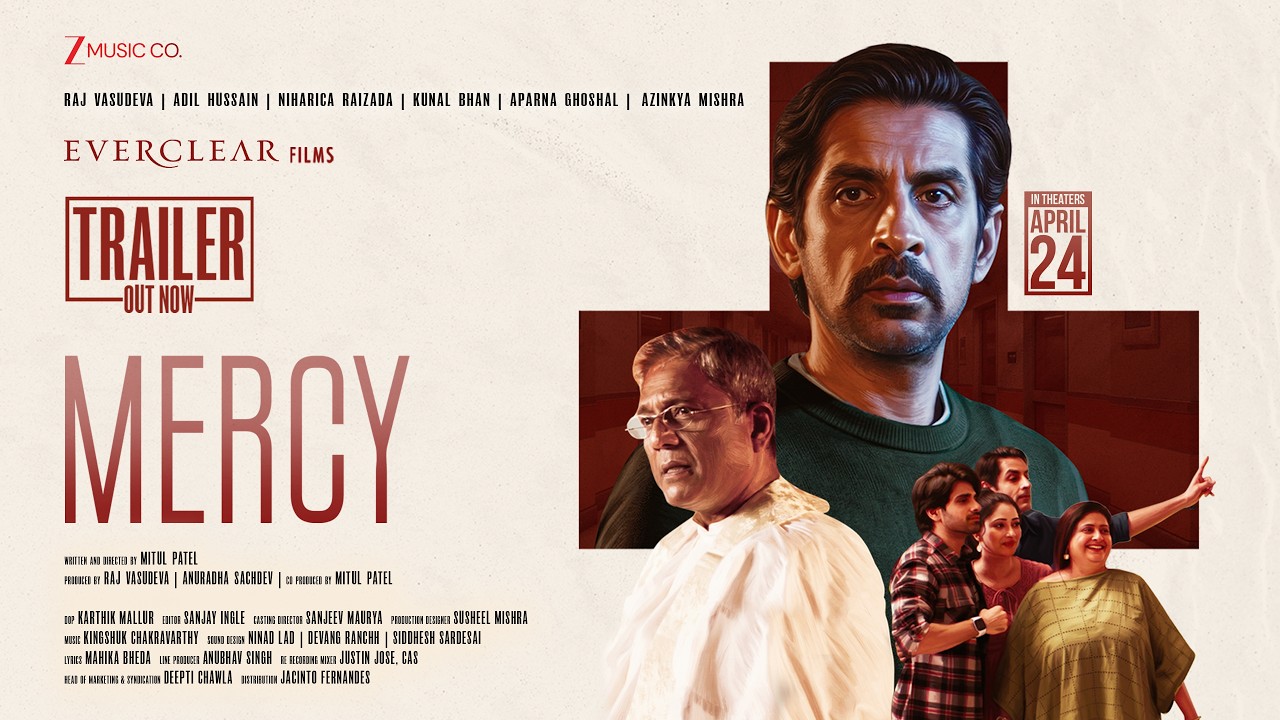
Mercy Movie 2026 Bapamtv Review Details
Mercy (2026) Review – A Gut-Wrenching Drama That Asks, “What Would You Do?”
Let me tell you something, friends. After four decades of watching films, very few leave me sitting in a silent theatre long after the credits roll, questioning my own moral compass. “Mercy” did exactly that. It’s not just a movie; it’s an experience that clings to your soul like a shadow.
The film unfolds over one tense Christmas Eve, where a man named Shekhar is forced to make an impossible decision: to continue life support for his terminally ill mother or to let her go. It’s a raw, intimate chamber drama that digs deep into the wounds of family, faith, and the true meaning of mercy.
| Role | Name | Notes |
|---|---|---|
| Director & Writer | Mitul Patel | The visionary behind this intense narrative |
| Shekhar | Raj Vasudeva | The protagonist carrying the film’s emotional weight |
| Father Joel | Adil Hussain | Adds profound depth and spiritual conflict |
| Jiya | Niharica Raizada | A key supporting character in the family drama |
| Vihaan | Kunal Bhan | Part of the close-knit circle |
| Sujata (Mother) | Aparna Ghoshal | The heart of the film’s central dilemma |
| Doctor | Ajay Dutta | Brings the clinical, harsh reality to the fore |
| Young Shekhar | Azinkya Mishra | Appears in crucial flashback sequences |
The Entertainment Factor: A Tense Rollercoaster of Emotions
If you’re walking in expecting a typical Bollywood mass entertainer, let me stop you right there. “Mercy” is a different beast. Its entertainment lies not in escapism, but in profound engagement. The film is a tightly wound coil of tension, unraveling in real-time. The single-night setting creates a claustrophobic pressure cooker where every glance, every silence, and every remembered flashback carries immense weight. You don’t watch it; you endure it with the characters, and that is its unique power.
Star Performance: Raj Vasudeva’s Career-Defining Anguish
Raj Vasudeva as Shekhar delivers a performance that should be studied in acting workshops. This isn’t about swagger or screen presence in the traditional hero sense. This is about the quiet devastation of a son crumbling under an unbearable burden. Every flicker of doubt in his eyes, every tremor in his hands feels painfully real. And then you have the legendary Adil Hussain. My god, the man can convey a universe of conflict with just a sigh. As Father Joel, he is the moral anchor, his calm exterior masking a turbulent sea of spiritual doubt.

Direction & Vision: Mitul Patel’s Intimate Grip
Director-writer Mitul Patel shows remarkable restraint and clarity of vision. In an era of bloated runtimes, he tells a complete, devastating human story in a crisp 100 minutes. His direction is unflinching, forcing the audience to sit with the discomfort, refusing to provide easy answers. The vision is stark, personal, and deliberately un-cinematic in a way that makes it profoundly cinematic. This is storytelling that trusts its actors and its audience’s intelligence.
Dialogues & Action Blocks: The Silence Speaks Volumes
Forget clap-worthy dialoguebaazi. Here, the most powerful moments are often the silent ones—the long hold on Shekhar’s face as he stares at the hospital monitor, the unspoken understanding between old friends. When dialogues do come, they are sharp, loaded, and land like a punch. There’s a clinical coldness in the doctor’s explanations that clashes violently with the emotional pleas of the family, creating a different kind of “action block”—a battle of ideologies in a sterile room.
| Mass Element | Rating (Out of 5) | Verdict |
|---|---|---|
| Action | 1 | None of the fist-fighting kind. The action is entirely emotional and psychological. |
| Songs | 2 | No lip-sync Bollywood numbers. A somber, score-driven soundtrack. |
| Comedy | 0 | This is a grief-stricken universe. Not a moment of intentional comedy. |
| Romance | 2 | Only in fleeting flashbacks, used to highlight what is being lost. |
Music & BGM: The Invisible Emotional Scaffolding
The background score by the Emmy-winning composer is a character in itself. It doesn’t manipulate; it accentuates. The tracks like “Mercy” and “I’m Sorry” are waves of melancholic sound that wash over the scenes, underlining the despair and the moral fog. It’s never intrusive, but you feel its absence in the stark silences. This is background music in the truest sense—it builds the world from the ground up.
Cinematography & Technical Craft: A Visually Stunning Agony
The cinematography is breathtaking in its intimacy. Using those sharp TRIBE7 lenses, the camera gets uncomfortably close, letting you see every pore, every tear, every suppressed emotion on the actors’ faces. The 2.20:1 aspect ratio gives it a classic, widescreen gravitas. And the sound design? In Dolby Atmos, the beep of a life-support machine becomes a terrifying heartbeat for the entire film. The technical team has created a world that is painfully beautiful and real.

Emotional High Points: Connecting to the Universal Heart
The film’s power lies in its universal question: What would you do? This isn’t about Shekhar alone; it’s about you in that room. The emotional high points are quiet—a hand held, a childhood memory recalled, a prayer whispered not in hope, but in desperation. It forges a heart connection not through melodrama, but through shared, terrifying vulnerability. You are not a spectator; you are a participant in this ethical trial.
| Audience Type | Will They Enjoy It? | Reason |
|---|---|---|
| Family (Traditional) | Maybe, with Caution | The theme is heavy but can spark important intergenerational conversations. |
| Youth (Commercial Seekers) | Likely No | Too slow, no glamour, no clear-cut heroism. Requires patience. |
| Drama Enthusiasts / Mass (For Content) | Absolutely Yes | This is premium, actor-driven cinema with a powerful core. Pure content. |
Box Office Prediction & Final Verdict
Given its moderate box office performance globally (around $54 million against a $60 million budget), its true victory will be on OTT platforms. This is a film made for curated viewing, for discussions, for the “hidden gem” tag. My final verdict? “Mercy” is a masterclass in performance and intimate storytelling. It is a difficult, demanding, but ultimately essential watch. It doesn’t entertain; it enlightens and devastates. A solid achievement for Hindi cinema.
| Category | Star Rating (Out of 5) | Insight |
|---|---|---|
| Story & Concept | 4.5 | Brave, timely, and executed with remarkable focus. |
| Acting | 5.0 | Flawless. A benchmark for ensemble acting. |
| Direction | 4.5 | Confident, restrained, and powerfully effective. |
| Music & BGM | 4.0 | Perfectly complements the mood without overpowering. |
| Visual Craft | 4.5 | Technically superb, with stunning, intimate cinematography. |
Frequently Asked Questions (FAQs)
Is Mercy (2026) a thriller or a drama?
It is purely a hard-hitting family drama. Do not confuse it with any other film of a similar name; this one has no sci-fi or thriller elements.
Is the movie too slow or depressing?
It is deliberately paced, building tension through emotions, not events. It is heavy and emotionally draining, but not gratuitously depressing. The depth is its strength.

Where can I watch Mercy (2026)?
The film had a theatrical release. It is expected to arrive on a major OTT platform soon, which is where such content-driven films find their most dedicated audience.
Ratings are purely my take after multiple watches — your experience might differ!