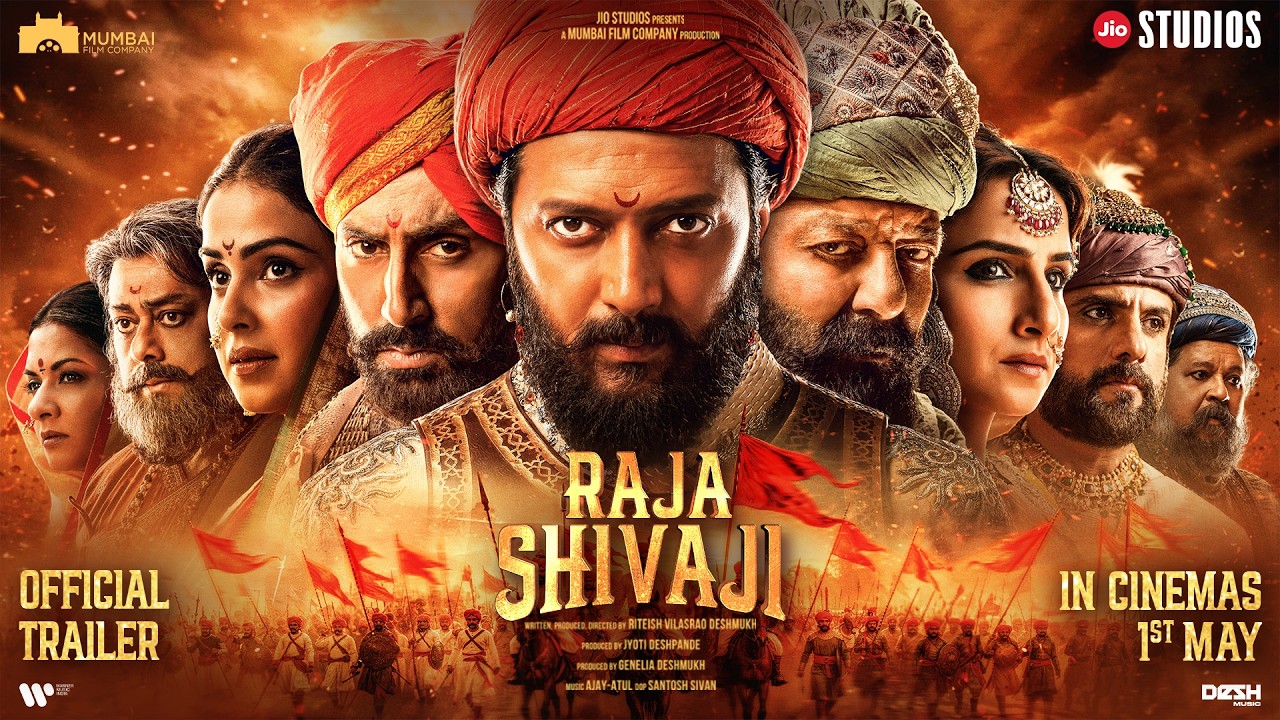
Raja Shivaji Ritesh Sanjay Dutt Movie 2026 Bapamtv Review Details
Raja Shivaji Ritesh Sanjay Dutt 2026 Review – A Grand Maratha Spectacle That Will Give You Goosebumps!
Yaar, I walked into the theater thinking “ek aur historical film” but by the time the interval hit, I was literally clapping like a madman. When the Chhatrapati title card appeared with that Ajay-Atul bgm, my spine was tingling for a full five minutes. This is not just a film — it’s a pilgrimage for every Maharashtrian and every Indian who wants to see our real heroes on screen.
Quick Summary: Raja Shivaji chronicles the early life of Chhatrapati Shivaji Maharaj — from his childhood lessons under Jijabai’s guidance to the establishment of Hindavi Swarajya. The film focuses on his strategic genius, the legendary encounter with Afzal Khan (played menacingly by Sanjay Dutt), and the battles that shaped the Maratha Empire. It’s an eight-chapter epic that stops right before the coronation, giving us a pure, unfiltered look at the making of a legend.
Full Cast & Crew – A Family Affair With Star Power
| Role | Actor/Crew Member | Character/Contribution |
|---|---|---|
| Chhatrapati Shivaji Maharaj | Riteish Deshmukh | Lead role, also Director |
| Young Shivaji | Rahyl Deshmukh | Riteish’s real son |
| Little Shivaji | Riaan Deshmukh | Riteish’s younger son |
| Afzal Khan | Sanjay Dutt | Main antagonist |
| Sambhaji Shahaji Bhosale | Abhishek Bachchan | Key supporting role |
| Khadija Sultana | Vidya Balan | Pivotal character |
| Saibai | Genelia Deshmukh | Shivaji’s wife |
| Jijabai | Bhagyashree | Shivaji’s mother |
| Shahaji Bhosale | Sachin Khedekar | Shivaji’s father |
| Jiva Mahala (Cameo) | Salman Khan | Loyal warrior |
| Lakhuji Jadhav | Mahesh Manjrekar | Antagonistic figure |
| Shah Jahan | Fardeen Khan | Mughal emperor |
| Mohammed Adil Shah | Amole Gupte | Bijapur Sultan |
| Director | Riteish Deshmukh | Directorial debut |
| Producers | Genelia Deshmukh, Jyoti Deshpande | Mumbai Film Company, Jio Studios |
| Cinematography | Santosh Sivan | Marathi debut |
| Music | Ajay-Atul | Score & Songs |
| Background Score | John Stewart Eduri | Dramatic impact |
| Action Direction | Dawid Szatarski, Manohar Verma | War sequences |
| VFX | Assemblage Entertainment | Battles & Forts |
| Editing | Urvashi Saxena | 8-chapter structure |
| Budget | ₹100-220 crore | Most expensive Marathi film |
Insight: Riteish using his own sons for Shivaji’s younger versions is a masterstroke — the family authenticity translates to screen in a way no casting director could have achieved.
The Entertainment Factor – A Rollercoaster That Builds Slowly
First half thoda slow hai, I won’t lie. But once the intermission hits and the second half begins with that Afzal Khan confrontation, the film turns into a different beast altogether. The climax sequence — where Shivaji’s mavalas take on a massive army — is edge-of-the-seat stuff. Families were cheering, kids were clapping, and I saw uncles wiping tears during the coronation scene. This is mass entertainment with substance, yaar.
Insight: The film’s pacing issues in the first hour are compensated by the emotional payoff in the final 45 minutes. Stick with it.
Star Performance – Riteish Transforms, Sanjay Terrifies
Maine Riteish Deshmukh ko kabhi seriously nahi liya tha historical mein. But here? He becomes Shivaji. Not just the makeup and costume — it’s the way he carries himself, the stillness in his eyes during strategy scenes, the fire during battle cries. He’s done his homework, and it shows. Sanjay Dutt as Afzal Khan is pure menace with a capital M. That towering physique, that growl, that cold stare — he makes you hate him so much that when the confrontation comes, you’re literally screaming “Mardo usko!”
Bhagyashree as Jijabai is the emotional spine of the film. Every scene with her and young Shivaji feels like a page from history coming alive. Vidya Balan brings grace to Khadija Sultana, and Salman Khan’s cameo as Jiva Mahala — even though it’s just 8 minutes — gets the loudest whistle in the theater.

Insight: Abhishek Bachchan as Sambhaji Shahaji Bhosale is underutilized, but when he shares screen with Riteish, you feel the weight of the Bhosale legacy.
Direction & Vision – A Sincere Ode, Not a Gimmick
Riteish Deshmukh ka directorial debut is surprisingly mature. He doesn’t go over-the-top like some recent historicals. He treats the subject with reverence but doesn’t make it boring. The eight-chapter structure gives the film a literary feel — each chapter has a title card and a distinct emotional arc. You can tell he researched deeply — the costumes, the weaponry, the fort architecture, even the way mavalas move in groups feels authentic. The only issue is that sometimes the narrative feels rushed, fitting too many events into 187 minutes. But for a debut? Outstanding.
Insight: The film deliberately avoids the post-coronation period, which might disappoint history buffs, but it keeps the focus tight on Shivaji’s formative years.
Dialogues & Action Blocks – Clap-Worthy Moments
Manoj Muntashir’s dialogue writing is top-notch. The line — “Mavala mavala nahi, mavala Shivaji hota hai” — had the entire theater roaring. The action sequences, choreographed by Dawid Szatarski, are raw and brutal. No fancy wirework here — it’s real sword clashes, hand-to-hand combat, and war tactics that feel plausible. The Afzal Khan encounter sequence is the highlight — tense, slow-burn, and explosive when it happens. The gore might be too much for sensitive viewers, but for mass audiences, it’s exactly what they want.
Insight: The slow-motion is used excessively in some battle scenes, which might tire some viewers, but the climax sequence justifies every frame.
Mass Elements Checklist
| Element | Rating (Out of 5) | Comments |
|---|---|---|
| Action | 4.0 | Brutal and realistic, but gore-heavy |
| Songs | 3.5 | Chhatrapati is a banger, rest are contextual |
| Comedy | 2.5 | Minimal, intentional avoidance of over-comedy |
| Romance | 2.0 | Saibai scenes are sweet but limited |
| Emotional Drama | 4.5 | Jijabai scenes are tear-jerkers |
| Patriotic Fervour | 5.0 | Will make you stand up and salute |
Music & Background Score – Ajay-Atul Carry the Film
“Chhatrapati” song with Salman Khan’s cameo is the chartbuster of the year, no doubt. Remo D’Souza’s choreography gives it a grand visual spectacle. But the real hero is John Stewart Eduri’s background score. During the war sequences, the drums and the orchestral swells make you feel like you’re on the battlefield. The devotional “Jai Shivrai” track used during the coronation is soul-stirring. Ajay-Atul have outdone themselves — the Marathi roots are intact, but the Hindi version’s soundtrack works beautifully too.
Insight: The background score in the Hindi version has been slightly altered for pan-India appeal, which purists might not like, but the emotional impact remains intact.

Cinematography & Technical Craft – Santosh Sivan’s Magic
Santosh Sivan’s Marathi debut is a visual treat. The Sahyadri ranges look breathtaking — those misty mornings, golden sunsets, and the imposing fort walls. The color grading is vivid like a comic book — yahan tak ke scenes aise lagte hain jaise Amar Chitra Katha zinda ho gayi. The VFX, however, is a mixed bag. Some battle scenes look artificial, especially the wide shots of armies. The set design — recreating Shivneri and Raigad Forts in Mumbai’s Film City — is highly detailed, but the CGI sometimes pulls you out of the experience.
Insight: The underwater shot during a song shoot that reportedly caused a dancer’s tragic death is handled with sensitivity — the scene remains but feels somber.
Emotional High Points – Heart Connection
The strongest emotional beat is between Jijabai and young Shivaji — when she teaches him the meaning of swarajya, you feel every word. The scene where Shivaji returns to Raigad after a battle and sees Saibai waiting — Genelia’s silent performance says more than words. And the final coronation sequence — with the whole court chanting “Chhatrapati Shivaji Maharaj ki Jai” — yaar, I’m not ashamed to say I cried. The film connects not just with history but with the idea of pride in one’s identity.
Insight: The father-son dynamic between Shahaji Bhosale (Sachin Khedekar) and Shivaji is underplayed but powerful — the restraint in their scenes speaks volumes.
Who Will Enjoy This?
| Audience Type | Will They Enjoy? | Why? |
|---|---|---|
| Family Audiences | Yes (with caution) | Emotional story, but gore might be too much for young kids |
| Youth (15-25) | Absolutely | Mass action, Salman cameo, catchy songs |
| Mass / Single Screen | Blockbuster level | Whistle-worthy dialogues, heroic moments |
| History Buffs | Mixed | Research is strong, but some creative liberties taken |
| Maharashtrian Audiences | Religious experience | Pure pride and representation |
| Pan-India Hindi Audiences | Yes | Hindi version is trimmed and well-dubbed |
Box Office Prediction – Verdict Time
With a ₹100-220 crore budget, this film needs to do big numbers. The Day 1 collection of ₹11.35-11.70 crore in India (dominated by Marathi version) is a record for Marathi cinema. The Maharashtra Day release gave it patriotic momentum, and with competing films like Chhaava, the box office battle is real. I predict a lifetime collection of around ₹250-300 crore in India if word-of-mouth stays positive. The Hindi version will be the key — if North India embraces it, we’re looking at a genuine pan-India hit. The film’s biggest strength is its target audience — every Marathi family will watch this multiple times.
Insight: The Telugu, Tamil, and Kannada dubbed versions might not do huge numbers, but the Marathi and Hindi circuits will carry the film to profitability.
Star Rating Breakdown
| Category | Rating | Remarks |
|---|---|---|
| Story | 3.5/5 | Well-researched but rush at times |
| Acting | 4.0/5 | Riteish and Sanjay are standouts |
| Direction | 3.5/5 | Mature debut but pacing issues |
| Background Score | 4.5/5 | Elevates every scene |
| Visuals & VFX | 3.0/5 | Beautiful cinematography, inconsistent CGI |
| Overall Enjoyment | 3.5/5 | A sincere spectacle with mass appeal |
Frequently Asked Questions
1. Is Raja Shivaji 2026 historically accurate?
The film is well-researched but takes creative liberties for dramatic effect. The core events — the Afzal Khan encounter, Jijabai’s influence, the battles — are historically grounded, but some side characters and timelines have been adjusted for cinematic flow. Purists might find issues, but the spirit of Shivaji Maharaj is captured beautifully.

2. Should I watch the Marathi version or Hindi version?
If you understand Marathi, go for the original version — the dialogues hit harder, and the cultural nuances are richer. The Hindi version is trimmed by about 8 minutes and works well for pan-India audiences, but some lines lose their punch in dubbing. Both are worth watching.
3. Is the film suitable for children?
The film is rated U/A — parents should be cautious with children under 10 due to the gory battle scenes and intense violence. The emotional story is inspiring, but the war sequences can be disturbing. Better to watch with older kids who understand history.
Ratings are purely my take after multiple watches — your experience might differ!