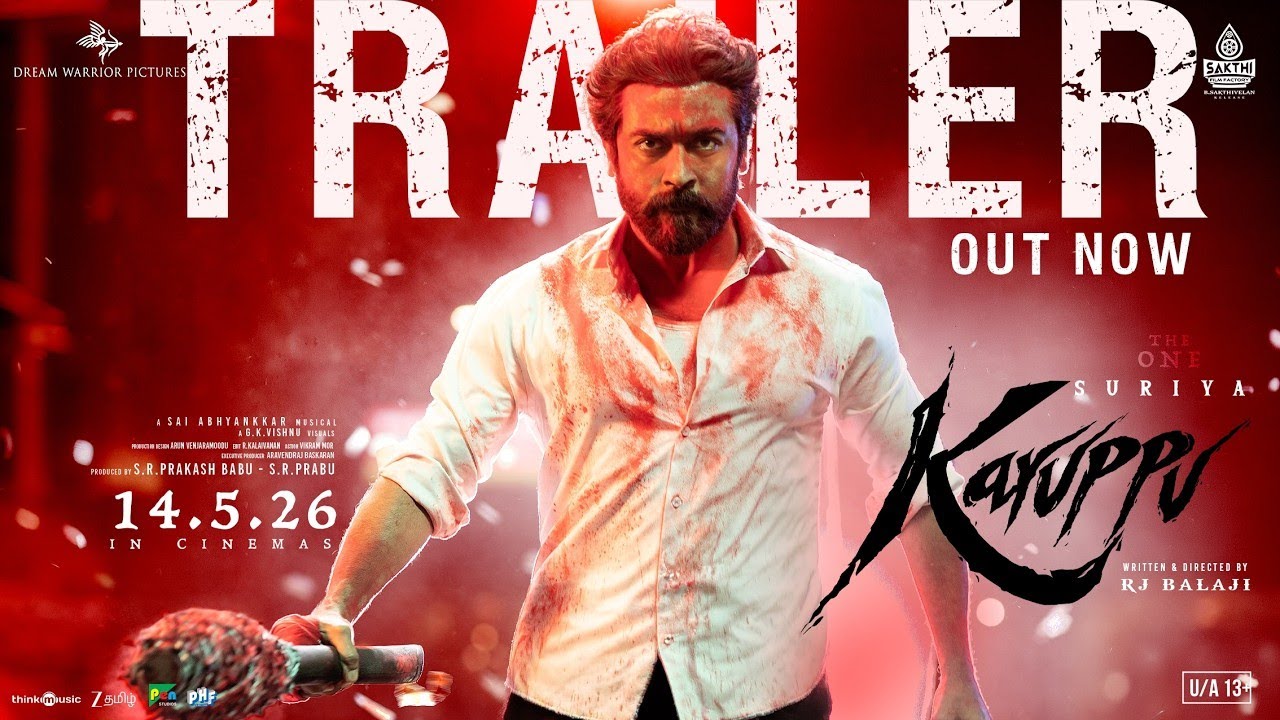
Karuppu Suriya Trisha Movie 2026 Bapamtv Review Details
Karuppu (Suriya–Trisha, 2026) Tamil Review – A Raw, Roaring Courtroom Mass Drama That Packs a Punch!
Yenna da ra, I walked into the theatre with zero expectations — only to walk out two hours and forty minutes later with my ears ringing and my heart thumping. This is not just a film; it is an experience. And let me tell you, as someone who has been reviewing Tamil cinema since the days of VHS tapes, Karuppu is that rare beast — a star vehicle that actually has something to say. Suriya, after a string of experimental roles, returns to his mass roots, and Trisha matches him beat for beat in a role that gives her real agency. RJ Balaji, the director, has cooked something special here — a courtroom drama that is loud, proud, and surprisingly heartfelt.
Let’s get straight to the gist: Karuppu is a social-action drama set in a fictional Tamil village where a fiery rural firebrand named Karuppasamy (Suriya) takes on a corrupt legal-political nexus. When a decades-old land-grab case reaches a breaking point, a principled lawyer (Trisha) steps in to fight for the oppressed. The film is built around the clash between “written law” and “unwritten justice”, with Suriya’s character using his fists and instincts while Trisha relies on procedure and evidence. The result? A courtroom showdown that is part Jai Bhim, part Mersal, and entirely mass.
Main Cast & Crew
| Role | Name | Character Description |
|---|---|---|
| Lead Actor | Suriya | Karuppasamy / Vetta Karuppu / Saravanan — a rural firebrand with a volcanic sense of justice |
| Lead Actress | Trisha Krishnan | A principled lawyer fighting for the oppressed, legal anchor in court |
| Director / Writer / Actor | RJ Balaji | Baby Kannan — the arrogant defence counsel and a key antagonist |
| Supporting Actor | Indrans | Rural elder / community figure affected by systemic injustice |
| Comedy Actor | Yogi Babu | Comic relief with a strong sub-textual role linked to the underprivileged community |
| Supporting Actress | Swasika Vijay (Swasika) | Woman from the affected village, adds emotional weight |
| Supporting Actress | Sshivada | Tied to village and family dynamics |
| Supporting Actress | Anagha Ravi | Junior lawyer working under Trisha’s character, seen in courtroom scenes |
| Supporting Actor | George Mariyan | Character role in the village/urban milieu |
| Antagonist Support | Mansoor Ali Khan | Legal/political nexus figure |
| Antagonist Support | Supreeth Reddy | Formidable rival or muscle element aligned with the establishment |
| Pivotal Supporting Actor | Natarajan Subramaniam (Natty) | Moral-dilemma scenes |
| Comic-Support | Kaali Venkat | Standout comedic scenes |
| Special Appearance | Prakash Raj | High-level authority figure (cameo) |
| Cinematography | Gopi Amarnath | Stylised, shadow-heavy visuals for the “Karuppu” persona |
| Music | Ilaiyaraaja | Folk-infused, high-energy score |
| Editing | Sathish Suriya | Fast-paced cuts for courtroom sequences and action set-pieces |
| Production | 2D Entertainment | Suriya’s own banner, pan-Asian release strategy |
| Dialogue & Screenplay | RJ Balaji | Didactic, punchy lines aimed at theatres and mass appeal |
Section 1: The Entertainment Factor — Pure Rollercoaster!
First things first, is Karuppu a drag or a rollercoaster? Rollercoaster, 100%. From the opening scene itself — where Suriya walks into a village festival with a deity procession in the background — you know you are in for a ride. The first half is a perfect blend of action, emotion, and setup. The village sequences are raw, the dialogues crackle, and the introduction of Trisha’s character is handled beautifully. The second half, dominated by the courtroom drama, is where the film slows down a bit — but not in a bad way. It becomes more of a tension-building exercise, with Balaji’s character using every legal trick in the book to frustrate our hero. The climax? Packed with clap-worthy moments that will make whistling mandatory.
Section 2: Star Performance — Suriya’s Swagger is Back!
If you have missed the old Suriya — the one from Ghajini and Singam — this film is your ticket. His screen presence is electrifying. The way he delivers punch dialogues, the way he carries the “Karuppu” aura with black-and-red stylised shots, the way he breaks down in emotional scenes — it is all top-notch. He plays three shades of the same character: the impulsive vigilante, the emotionally burdened son of the soil, and the legal warrior. Trisha, on the other hand, delivers a career-best performance in a mass film. She is not just a love interest; she is the moral compass of the story. Her courtroom arguments are sharp, and her chemistry with Suriya is mature and grounded.
Insight: Suriya’s dual-track portrayal — impulsive rural leader and restrained courtroom presence — is the film’s core anchor. Without his conviction, this film would have fallen flat.

Section 3: Direction & Vision — RJ Balaji’s Mass Statement
RJ Balaji, as a director, has taken a huge leap from his previous satirical comedies. Here, he blends social commentary with mass entertainment in a way that reminds you of Shankar’s early work, but with a more grounded, folk-infused aesthetic. His vision is clear: show the corruption in the legal system without making it boring. He uses the courtroom as a battleground, not a lecture hall. The pacing is tight in the first half, though the second half does rely heavily on dialogue-heavy sequences. But Balaji manages to keep you invested through the performances and the gradual build-up to the climax. His direction of the mass elements — the chants, the slow-motion walks, the punch dialogues — is spot on.
Section 4: Dialogues & Action Blocks — Clap-Worthy Moments Every 10 Minutes
This is where Karuppu truly shines. The dialogues are written for the theatre experience. Lines like “Unwritten justice is still justice, thalaiva” and “Karuppu na kodumai illa, kodumaiya eduthu katturavan” will have the crowd roaring. The action blocks are minimal but impactful — one particularly stunning sequence involves Suriya taking on a gang in a narrow village lane, shot with handheld cameras and quick cuts. The climax courtroom speech is a masterclass in mass dialogue delivery. Balaji’s character, as the antagonist lawyer, also gets some killer lines that make you genuinely hate him.
Table 2: Mass Elements Checklist
| Element | Rating (Out of 5) | Remarks |
|---|---|---|
| Action Sequences | 4.0 | Raw, village-based, realistic but stylised |
| Songs | 4.5 | Ilaiyaraaja’s folk anthems are the heart of the film |
| Comedy | 3.5 | Yogi Babu and Kaali Venkat provide relief, not overdone |
| Romance | 3.5 | Understated but effective, “Kadhal Kandaan” is a standout |
Section 5: Music & BGM — Ilaiyaraaja’s Magic Touch
Ilaiyaraaja, at his age, still knows how to make a film pulse with energy. The soundtrack is not just background music; it is a character in itself. The hero-introduction anthem “Raathu Raasan” is already a chartbuster, with rapid percussive beats and Suriya-centric visuals. “Verappa” is the mass-punch track you will hear in every theatre, with repetitive chants that become addictive. The “Maasani Amman Theme” is a slow-burning folk track that grounds the emotional scenes. And the “Courtroom March” instrumental — with staccato strings and marching-drum beats — elevates every legal confrontation. The BGM does not overpower the dialogues; it amplifies the tension perfectly.
Insight: Ilaiyaraaja blends traditional Urumi/Thappu rhythms with modern synth layers, giving the film a distinct “ritual-action” feel that is rare in mainstream Tamil cinema.
Section 6: Cinematography & Technical Craft — Gopi Amarnath Shines
Gopi Amarnath’s cinematography is a visual treat. The “Karuppu” persona is shot with black-and-red filters and subtle glow effects, making Suriya look larger-than-life without being cartoonish. The village exteriors are gritty and raw, while the courtroom sets are sleek and modern — a visual representation of the clash between rural justice and urban law. The weather enhancements — stormy skies during key confrontations — add to the dramatic tension. The VFX is not fantasy-heavy but works well for crowd extensions and symbolic aura effects. The sound design, in Dolby Atmos, is particularly effective — the silence-to-blast contrasts during emotional scenes will give you chills.

Section 7: Emotional High Points — The Heart Connection
For all its mass elements, Karuppu has a surprising emotional core. The relationship between Suriya and Indrans, the village elder, is touching. The scene where Trisha’s character breaks down after losing a crucial court motion — and Suriya silently stands beside her — is one of the most powerful moments in the film. The climax, where Suriya risks everything to force a symbolic verdict, will leave you with a lump in your throat. The film successfully balances theatre-roaring moments with genuine heart.
Table 3: Who Will Enjoy This?
| Audience Segment | Will They Enjoy? | Reason |
|---|---|---|
| Family Audience | Yes | Clean violence, strong social message, emotional core |
| Youth | Yes | Mass dialogues, action blocks, Ilaiyaraaja’s anthems |
| Mass/Class Fans | Yes | Driven by Suriya’s swagger and Balaji’s punchy direction |
| Art-House/Cinephiles | Mixed | Formulaic plot structure may feel repetitive; mass elements dominate |
| Suriya-Trisha Fans | Absolutely | This is the reunion they have been waiting for |
Section 8: Box Office Prediction — A Strong Start with Steady Legs
Trade reports indicate a robust opening. Day 1 India net was approximately ₹14.40 crore, with Tamil Nadu contributing ₹12 crore. Chennai alone hit ~70% occupancy. Worldwide, the film grossed around ₹20.66 crore on Day 1. This is a strong start, but it did not break records. The film’s longevity will depend on weekday occupancy and word-of-mouth around the courtroom scenes. Given the positive buzz and the festival-season release, I expect steady legs with a potential total of ₹100-120 crore in India. The overseas market — Gulf, Malaysia, Singapore — will add another ₹20-25 crore. A safe hit at the box office, but not a blockbuster.
Table 4: Star Rating Breakdown
| Parameter | Rating (Out of 5) | Remarks |
|---|---|---|
| Story & Screenplay | 3.5 | Formulaic but effective; familiar beats but strong execution |
| Acting (Lead & Ensemble) | 4.0 | Suriya is in top form; Trisha matches him; Balaji is a solid antagonist |
| Direction | 3.5 | RJ Balaji shows ambition; pacing dips in second half but vision is clear |
| Background Score & Songs | 4.5 | Ilaiyaraaja delivers a career-defining mass score; songs are chartbusters |
| Cinematography & Visuals | 4.0 | Gopi Amarnath’s stylised visuals elevate the mass quotient |
| Overall Rating | 3.8 / 5 | A strong mass entertainer with heart and punch |
3 Frequently Asked Questions (FAQs)
1. Is this film similar to ‘Jai Bhim’ or is it a typical mass film?
It is a hybrid. The social-justice theme and courtroom elements are reminiscent of Jai Bhim, but the treatment is purely mass — with punch dialogues, stylised action, and Suriya’s star power. Think Jai Bhim meets Mersal.
2. Does Trisha have a substantial role, or is she just a love interest?
She has a very substantial role. Her character is a principled lawyer who fights alongside Suriya. She has multiple courtroom scenes, emotional arcs, and her own moral dilemmas. This is one of the best-written female roles in a Suriya film in years.
3. Is the film too slow in the second half due to the courtroom drama?
The second half is dialogue-heavy, but it never drags. The tension is built through sharp exchanges, character confrontations, and a gradual build-up to the climax. If you enjoy legal dramas, you will love it. If you only want action, you might find some stretches a bit talkative.

Ratings are purely my take after multiple watches — your experience might differ!