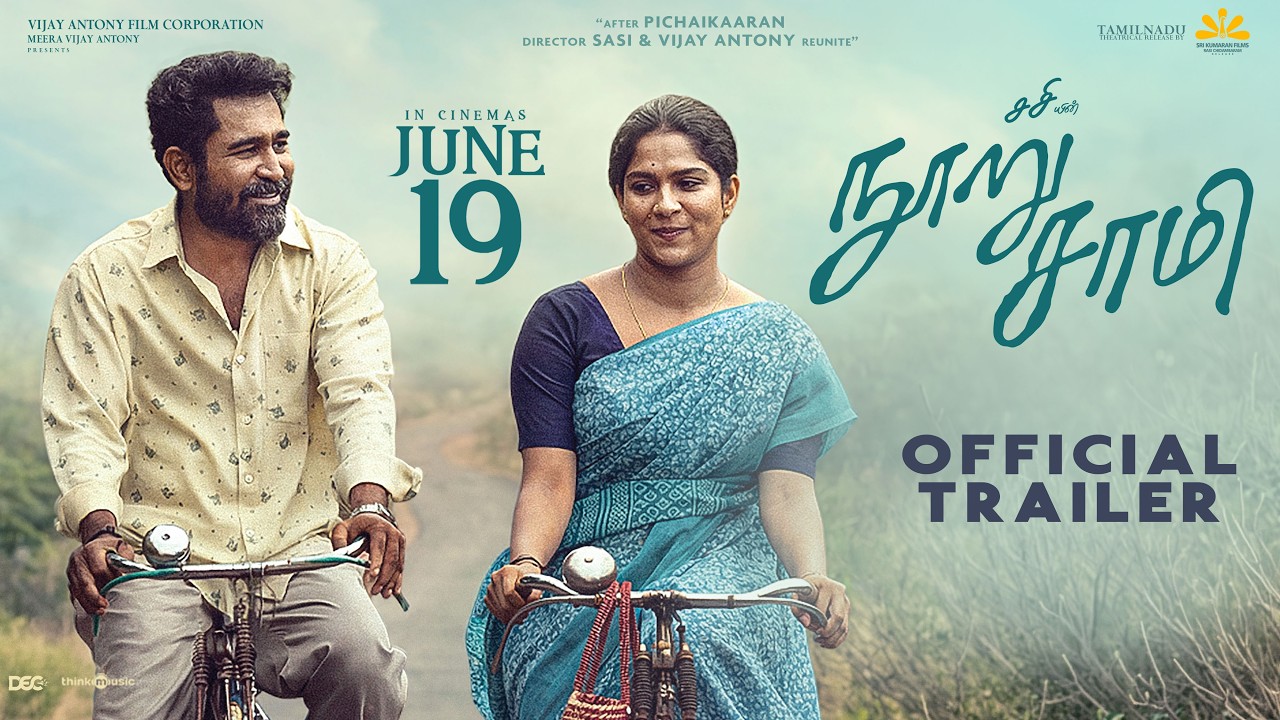
Nooru Saami Vijay Antony Movie 2026 Bapamtv Review Details
Nooru Saami (2026) Tamil Movie Review – Swasika’s Powerful Performance Lifts This Social Drama!
Yaar, let me be honest with you. When I first heard that Vijay Antony was doing a film called Nooru Saami where he doesn’t even have major screen time, I was skeptical. But after watching this film twice in the theatre, I have to say – this is not your typical mass masala movie. This is a film that stays with you, that makes you think, that touches something deep inside. And Swasika? She has delivered one of the finest performances I have seen in recent Tamil cinema.
Set in a traditional Tamil village, Nooru Saami tells the story of Selvi, a widowed mother who has spent years sacrificing her own happiness for her children. When she decides to remarry, the entire village rises against her, questioning her morality and right to choose. The film is not about action or romance – it is about dignity, freedom, and the courage to stand alone against centuries of tradition. Directed by Sasi, this 2-hour-10-minute rural drama released on June 19, 2026, and carries a UA 13+ certification.
| Name | Role / Credit |
|---|---|
| Vijay Antony | Ezhumalai / Actor-Producer |
| Swasika Vijay | Selvi (Lead Protagonist) |
| Ajay Dhishan | Bhasker |
| Lijomol Jose | Angela Sister |
| Kavya Anil | Vandhana |
| Karunas | Selvi’s Brother |
| Sakthi Raj | Vivek |
| Balaji Sakthivel | Pachaiperumal |
| Aruldoss | School Teacher |
| Munishkanth | Police Inspector |
| Padine Kumar | Sandhya |
| Bagavathi Perumal | Vandhana’s Father |
| Vinodhini Vaidyanathan | Vandhana’s Mother |
| Moorthy | Supporting Role |
| Subramaniam Siva | Supporting Role |
| Darshan Kirlosh | Cinematographer |
| Kannan Balu | Editor |
| Balaji Sriram | Music Composer |
| Mohan Rajan | Lyricist |
| Fathima Vijay Antony | Co-Producer |
| V. Sasi Kumar | Art Director |
Section 1: The Entertainment Factor – Emotional Rollercoaster, Not Mass Ride
Do not come expecting punch dialogues and whistle-worthy moments. This film is a slow burn, a deliberate emotional journey that builds steadily. The first half sets up Selvi’s world – her sacrifices, her loneliness, her quiet dreams. The interval block gives you the first major conflict, and from there, the second half becomes increasingly intense. There are no dance numbers in bars, no hero introduction songs. Instead, you get raw confrontations, silent tears, and moments of quiet rebellion. For me, this was more engaging than any mass commercial film because it felt real. The entertainment here comes from emotional investment, not spectacle.
Section 2: Star Performance – Swasika Carries the Entire Film on Her Shoulders
Honestly, I have to say this without any hesitation – Swasika Vijay is the soul of Nooru Saami. Her portrayal of Selvi is nothing short of extraordinary. The way she conveys decades of suppressed pain through just her eyes, the way her voice breaks in crucial scenes, the dignity she maintains even when the world humiliates her – this is award-worthy work. Vijay Antony’s role as Ezhumalai is limited, but he makes an impact in his scenes. His screen presence is restrained, almost understated, which actually helps the narrative because the focus stays where it belongs – on Selvi. Ajay Dhishan as Bhasker delivers a solid performance as the conflicted son. Karunas provides some relief, but this is Swasika’s film all the way. I have seen many Tamil heroines get wasted in commercial films, but here, finally, an actress gets a role that lets her show her full range.

Section 3: Direction & Vision – Sasi Handles Sensitive Subject with Maturity
Director Sasi deserves credit for treating this subject with the seriousness it deserves. He does not resort to melodrama or cheap sentiment. The pacing is deliberate, sometimes slow, but always purposeful. He lets scenes breathe, allowing the audience to feel the weight of each moment. The village feels authentic – not the glossy, stylized villages we see in commercial cinema, but a real, dusty, conservative community where everyone knows everyone’s business. Sasi’s vision is clear: this is not about a hero saving a woman, but about a woman saving herself. That distinction makes all the difference. The only weakness is that the familiar beats of Tamil social drama appear – the village meeting, the moral policing, the family confrontation – and some viewers may find the structure predictable. But within that structure, Sasi maintains honesty.
Section 4: Dialogues & Action Blocks – Words That Hit Hard
There are no action sequences in the traditional sense, and that is perfectly fine. The real battle here is verbal and emotional. The dialogues are sharp, simple, and devastatingly effective. One line where Selvi asks, “Enaku vazhka oru vazhi illaya?” (Is there no way for me to live?) stayed with me for days. The confrontations between Selvi and the village elders are brilliantly written – no shouting, just painful, quiet arguments that expose hypocrisy. There is a scene where her own son questions her choice, and the silence that follows is more powerful than any punch. The film’s strength is in these human moments, not in spectacle.
| Mass Element | Rating (Out of 5) | Remarks |
|---|---|---|
| Action Blocks | 1.5 / 5 | No physical action; emotional confrontation only |
| Songs | 3.0 / 5 | Melodic, situational, not commercial |
| Comedy | 2.5 / 5 | Minimal, natural humor from Karunas |
| Romance | 3.5 / 5 | Subtle, mature, not youthful love story |
| Emotional Impact | 4.5 / 5 | Heart-touching, leaves you thinking |
| Vijay Antony Swagger | 2.0 / 5 | Limited screen time, no mass moments |
| Family Appeal | 4.0 / 5 | Strong for mature family audiences |
Section 5: Music & BGM – Balaji Sriram Delivers Gentle, Effective Score
Balaji Sriram’s music is not designed for the charts. It is meant to enhance mood and emotion, and in that, it succeeds admirably. The background score is minimal but effective – during Selvi’s moments of quiet despair, the strings gently swell without overpowering the scene. The songs, though not fully documented in public sources, appear to be situational melodies that support the narrative rather than interrupt it. There is no item number, no peppy club song. Instead, there are folk-tinged tunes that feel organic to the village setting. For a film like this, that is exactly the right approach. The sound design deserves mention too – the ambient sounds of the village, the chirping of birds, the distant temple bells – all create an immersive rural atmosphere.
Section 6: Cinematography & Technical Craft – Rooted Realism Over Gloss
Darshan Kirlosh’s cinematography is one of the film’s quiet strengths. He captures the village without romanticizing it – the dusty roads, the narrow lanes, the modest homes, the open fields. The color palette is warm but not overly saturated. There are no showy crane shots or fancy filters. Everything serves the story. The editing by Kannan Balu keeps the pace steady, though some may find the first half slow. The art direction by V. Sasi Kumar is authentic, creating a believable domestic space for Selvi. In terms of VFX, this film does not rely on digital effects at all, and that is refreshing. The focus is on human performance and realistic environments. The technical team has clearly prioritized emotional truth over technical flashiness.

Section 7: Emotional High Points – Scenes That Will Make You Cry
Let me tell you about two scenes that broke me. The first is when Selvi finally tells her children about her decision. Her voice shakes, but she does not apologize. She simply says she has lived for others long enough. The second is the climax confrontation where the entire village gathers to judge her. Swasika’s monologue in that scene is one of the finest pieces of acting I have seen in Tamil cinema recently. She does not shout, she does not weep dramatically – she just speaks her truth with quiet dignity, and that is more powerful than any theatrical meltdown. These moments connect because they feel universal. Every woman watching will understand Selvi’s struggle. Every family will recognize the dynamics. That is the film’s greatest achievement – making a specific village story feel like everyone’s story.
| Audience Segment | Will They Enjoy? | Reason |
|---|---|---|
| Family Audiences | Yes – Highly Recommended | Mature handling of family conflict, relatable |
| Youth | Mixed | Slow pace may test patience; no mass elements |
| Mass / Commercial Fans | Not Really | No hero-centric moments, limited action |
| Women / Female Viewers | Yes – A Must Watch | Empowering story, strong female protagonist |
| Vijay Antony Fans | Moderate | Limited screen time may disappoint |
| Social Drama Lovers | Yes – Excellent | Strong theme, emotional depth, realism |
| Film Critics / Cinephiles | Yes | Solid craft, performance-driven cinema |
Section 8: Box Office Prediction – Steady Performer with Word-of-Mouth Momentum
Based on available tracking data, Nooru Saami has performed respectably for a mid-budget social drama. The film earned approximately ₹0.75 crore net in India on opening day, growing to ₹1.22 crore on day two, bringing the two-day India net to around ₹1.97 crore. Reports from Sacnilk indicate a three-day collection of ₹4.0 crore across 3,322 shows, with daily figures improving from ₹0.8 crore to ₹1.3 crore to ₹1.9 crore. Worldwide gross is reported at approximately ₹11.93 crore, with India gross at ₹10.73 crore and overseas contributing ₹1.20 crore, while India net stands at about ₹9.46 crore. These numbers tell a story of positive word-of-mouth – the trend moving upward after day one suggests audiences who watched it recommended it to others. For a serious drama without mass-market appeal, this is a meaningful achievement. The film may not break records, but it has found its audience.
| Category | Rating (Out of 5) |
|---|---|
| Story / Premise | 4.0 / 5 |
| Acting (Overall) | 4.5 / 5 |
| Direction | 3.5 / 5 |
| Background Music | 3.5 / 5 |
| Cinematography / Visuals | 4.0 / 5 |
| Dialogues | 4.0 / 5 |
| Emotional Impact | 4.5 / 5 |
| Entertainment Value | 3.0 / 5 |
| Overall Experience | 3.8 / 5 |
Frequently Asked Questions (FAQs)
Q1: Is Nooru Saami a mass entertainer like Vijay Antony’s previous films?
No, not at all. This is a serious social drama focused on a widow’s struggle to remarry in a conservative village. Vijay Antony has limited screen time. The film relies on emotional weight and strong performances, especially from Swasika, rather than action, dance, or commercial elements. If you expect mass moments, you will be disappointed. But if you appreciate meaningful cinema, this is worth your time.
Q2: How is Swasika’s performance in the film?
Honestly, Swasika delivers one of the finest performances by a female lead in recent Tamil cinema. She carries the entire film on her shoulders with extraordinary subtlety and emotional depth. Her portrayal of Selvi – a woman fighting for her dignity and right to happiness – is award-worthy. This is a career-defining role for her, and she makes every scene count, especially the climax confrontation.

Q3: Is the film suitable for family viewing?
Yes, absolutely. Nooru Saami carries a UA 13+ certification and deals with mature themes but without any vulgarity or excessive violence. It is a family drama that will resonate particularly with older audiences and women. The subject – a widow’s right to remarry – is handled with sensitivity and dignity. However, young children may find the slow pace boring, so it is best suited for mature family members who appreciate meaningful storytelling.
Ratings are purely my take after multiple watches — your experience might differ!