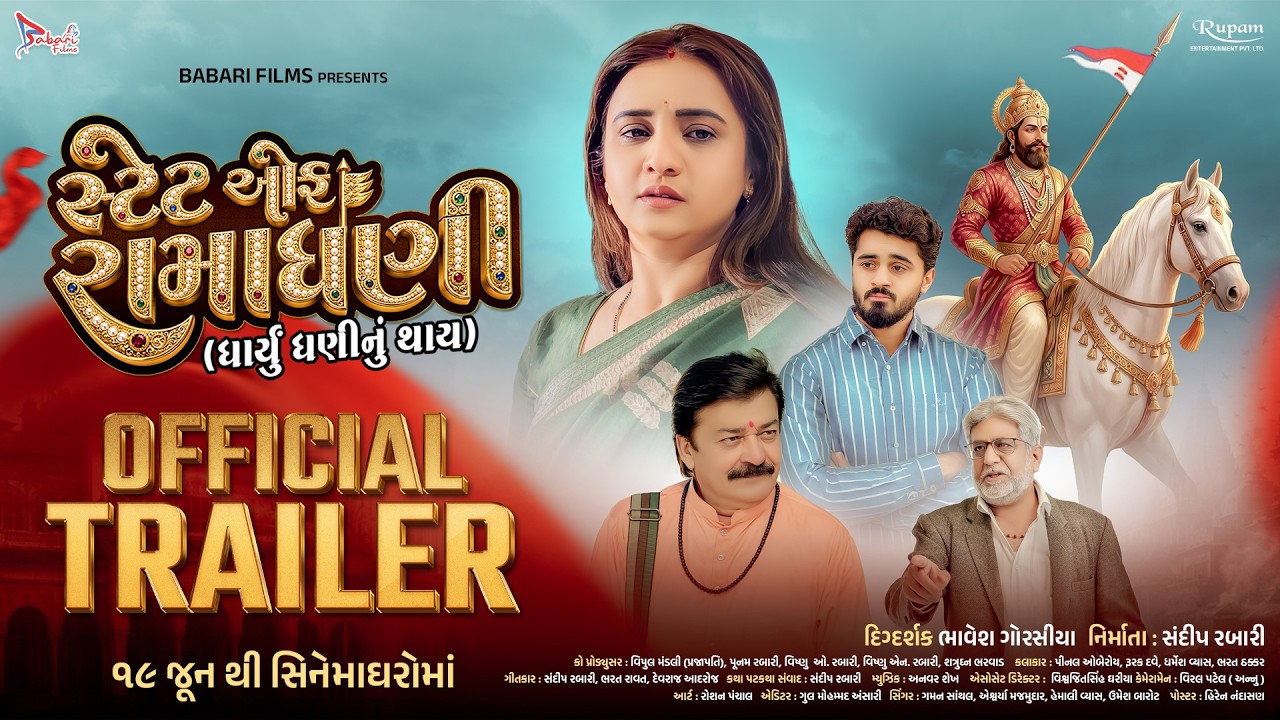
State Of Ramadhani Movie 2026 Bapamtv Review Details
State Of Ramadhani 2026 Review – A Soul-Stirring Gujarati Drama That Balances Faith & Reason!
Yaar, when I first heard about State Of Ramadhani, I thought “another devotional film with loud bhajans and forced tears.” But after watching it twice in the theater, I have to say — this one genuinely surprised me. It’s not a preachy film. It’s a family conflict that mirrors what happens in so many Gujarati homes when faith and medical reality clash. Let me share my honest thoughts.
Quick Summary: Set in a small Gujarati town centered around a local shrine called Ramadhani, the story follows Bhakti (Prinal Oberoi), a deeply spiritual wife, and her husband Yash (Rurook Dave), a practical man who believes in science and facts. When a series of events are seen as miracles by the community, their marriage, family, and moral beliefs are tested. A family medical emergency forces them to choose between divine faith and medical treatment — with life-altering consequences.
Main Cast & Crew
| Role | Name |
|---|---|
| Director | Bhavesh Gorasiya |
| Producers | Sandip Rabari, Punam Rabari, Vishnu N. Rabari, Vishnu O. Rabari, Shatrughan Bharwad |
| Bhakti (Lead) | Prenal Oberoi |
| Yash (Lead) | Ruruk Dave |
| Guruji | Dharmesh Vyas |
| Dr. Romit | Bharat Thakkar |
| Music | Aishwarya Majmudar, Umesh Barot, Gaman Santhal |
| Lyricist | Sandip Rabari |
| Cinematography | Production Team |
| Editing | Production Team |
| VFX & Sound | Local Post-Production Houses |
| Runtime | Approx. 2 hrs 17 mins |
| Release Date | 19 June 2026 (Gujarat Theatres) |
| Certificate | U (Family) |
1. The Entertainment Factor – Rollercoaster or Slow Drag?
Honestly, this is not a mass masala film with punch dialogues every 5 minutes. It’s a slow-burn family drama that builds tension like a pressure cooker. The first half establishes the family warmth and the community’s devotion — peaceful but not boring. The second half, especially after the medical emergency, grips you emotionally. There are moments when you feel the conflict in your own chest. But yes, the middle act does stretch a bit. If you are used to fast-paced commercial cinema, you might feel the drag. But for those who love character-driven stories, it’s a rewarding ride.
Insight: The director deliberately avoids melodrama. He lets silence and small gestures speak louder than loud dialogues. That is rare in Gujarati cinema today.
2. Star Performance – Hero’s Swagger and Screen Presence
Prinal Oberoi as Bhakti is the soul of this film. She doesn’t overact or cry unnecessarily. Her devotion feels real — not staged. You can see the conflict in her eyes when she has to choose between her husband’s logic and her faith. Ruruk Dave as Yash is equally good. He plays the skeptical husband without becoming arrogant or unlikeable. You understand his frustration. Dharmesh Vyas as Guruji is a pleasant surprise — he is not a typical “godman” villain. He has layered shades. Bharat Thakkar as Dr. Romit brings the necessary clinical coldness, but with a hint of empathy. The supporting cast, including relatives and villagers, adds authenticity. Nobody feels like a cardboard cutout.
Insight: The chemistry between Prinal and Ruruk is the film’s backbone. Their silent arguments are more powerful than loud fights.

3. Direction & Vision – Bhavesh Gorasiya’s Careful Hands
Bhavesh Gorasiya has made a brave choice — he doesn’t take sides. He doesn’t say “faith is blind” or “science is everything.” He simply shows the human cost of both extremes. The direction is mature and restrained. The hospital corridor sequence where chants and monitor beeps overlap is brilliantly staged. He lets the camera observe rather than judge. However, the pacing in the middle could have been tighter. Some community scenes feel repetitive. But overall, his vision is clear: this is a film about empathy, not a debate winner.
Insight: The film’s refusal to give a neat, happy ending is a bold directorial choice. It respects the audience’s intelligence.
4. Dialogues & Action Blocks – Clap-Worthy Moments
Don’t expect mass punchlines like “Mera naam hai Yash, aur main fact se nahi darta.” The dialogues are natural, rooted in Gujarati everyday speech. But there are moments that hit hard. One line by Guruji: “Shraddha andar thi aave, upar thi thopi na jay” (Faith comes from within, it cannot be forced from outside) — that got a whistle in my show. Another scene where Yash tells Bhakti, “Mane teri shraddha par aapatti nahi, par bachche ki jaan par aapatti hai” (I have no problem with your faith, but I object when it risks our child’s life) — pure gold. Action blocks are non-existent; this is a drama, not a fight film.
Insight: The best dialogue is in the silences between conversations. Watch the actors’ eyes.
5. Mass Elements Checklist
| Element | Rating (Out of 5) | Remarks |
|---|---|---|
| Action | 1.5 | No fights; emotional conflict is the only action. |
| Songs | 3.5 | Devotional bhajans and soulful folk tracks. |
| Comedy | 2 | Light humor from village characters, not laugh-out-loud. |
| Romance | 3 | Marital warmth, not typical love story. |
| Emotional Drama | 4.5 | Heart-wrenching in second half. |
| Mass Appeal | 2.5 | Family audiences will connect; mass youth may find slow. |
6. Music & BGM – Impact on the Narrative
The soundtrack is woven into the narrative like a sacred thread. The opening bhajan sets the tone of the temple town. The duet between Bhakti and Yash — a soft, melancholic number — shows their love before the conflict. The temple chorus sequence is purposefully loud to show community pressure. The female solo during Bhakti’s private doubt is haunting. Aishwarya Majmudar’s voice adds soulfulness. The background music by Umesh Barot and team is understated — no jarring beats, only subtle strings and flute that complement the mood. The BGM during the hospital scene is minimalist — just a low drone and heart monitor sounds — and it works powerfully.
Insight: The music never overpowers the dialogue. It sits in the background like a silent observer.

7. Cinematography & Technical Craft – Visuals That Speak
The cinematography focuses on warm, earthy tones — golds, browns, and greens of rural Gujarat. The temple is shot with natural light, giving it a sacred glow. Home interiors feel lived-in. The camera stays close to the actors during emotional scenes, making you feel their tension. The VFX is minimal — slight enhancement of light during “miraculous” moments, crowd duplication for temple gatherings. It’s not a visual spectacle, but it doesn’t need to be. The sound design is crisp — temple bells, chants, and village ambience are mixed cleanly. The editing is respectful of the story, though some middle scenes could have been trimmed by 5-7 minutes for pacing.
Insight: The film uses darkness and light symbolically — Bhakti is often in warm light, Yash in cooler tones. Notice the color palette shift as conflict deepens.
8. Emotional High Points – Heart Connection
The film’s strongest emotional beat is the hospital corridor scene I mentioned earlier — Bhakti praying while doctors work. Another moment is when Yash breaks down silently in the car, unable to express his fear. The final confrontation between Bhakti and Guruji is not loud but devastating. The climax, without giving spoilers, leaves you with a lump in your throat. It’s not a cry-fest, but a thoughtful silence. The film doesn’t manipulate your emotions; it earns them.
Insight: The scene where the child asks “Maa, dev bhagwan bimarone sacha kare che?” (Ma, does God really heal the sick?) — that question stays with you long after the credits.
9. Who Will Enjoy This?
| Audience Segment | Enjoyment Likelihood | Reason |
|---|---|---|
| Family audiences | High | Relatable conflict, emotional depth, clean content. |
| Youth (urban) | Moderate | Slow pacing may test patience; but thoughtful youth will connect. |
| Mass/Commercial fans | Low | No fights, no punchlines, no item numbers. |
| Devotional/faith-based viewers | Very High | Respectful portrayal of faith, not mockery. |
| Art-house/parallel cinema fans | High | Nuanced storytelling, moral complexity. |
10. Box Office Prediction – Verdict
State Of Ramadhani opened on 19 June 2026 with modest collections but steady word-of-mouth. It’s not a blockbuster in the commercial sense, but it is a success in its own right — especially in family-heavy shows and smaller towns. The film has found its audience among Gujarati families who appreciate meaningful cinema. Digital release will likely expand its reach. For a mid-budget regional drama, this is a solid, respectable performance. It won’t break records, but it will be remembered as a film that dared to ask difficult questions without shouting.
Final Verdict: A thoughtful, well-acted, and culturally rooted Gujarati film that handles the faith-versus-science debate with empathy and maturity. Not for those seeking mass entertainment, but highly rewarding for viewers who love emotional realism and moral complexity.

11. Star Rating Breakdown
| Category | Rating (Out of 5) |
|---|---|
| Story & Screenplay | 3.5 |
| Acting (Lead & Supporting) | 4.0 |
| Direction | 3.5 |
| Music & BGM | 3.5 |
| Cinematography & Visuals | 3.5 |
| Emotional Impact | 4.5 |
| Overall (Average) | 3.7 / 5 |
12. Frequently Asked Questions (FAQs)
1. Is State Of Ramadhani a religious film or a family drama?
It is a family drama that uses religious faith as a central conflict. It does not preach any religion; it shows how faith and medical reality can clash in a family. Suitable for all audiences regardless of personal beliefs.
2. Is the film suitable for children?
Yes, the film has a U certificate and is family-friendly. There is no violence, vulgarity, or adult content. However, younger children may find the slow pacing and emotional intensity less engaging.
3. Where can I watch State Of Ramadhani after theaters?
As of now, the film is in select Gujarati theaters. An OTT release on platforms like ShemarooMe or others is expected within a few months, but no official date has been announced. Keep an eye on regional streaming updates.
Ratings are purely my take after multiple watches — your experience might differ!